

We integrate manual, semi-automatic and automatic tightening systems.
A screwdriver with torque and angle control, combined with operation sequence control, reduces assembly errors, and recording the results ensures full product traceability. The station does not allow a screw to be skipped, the wrong fastener to be used or a part to be passed on if even one joint is NOK.
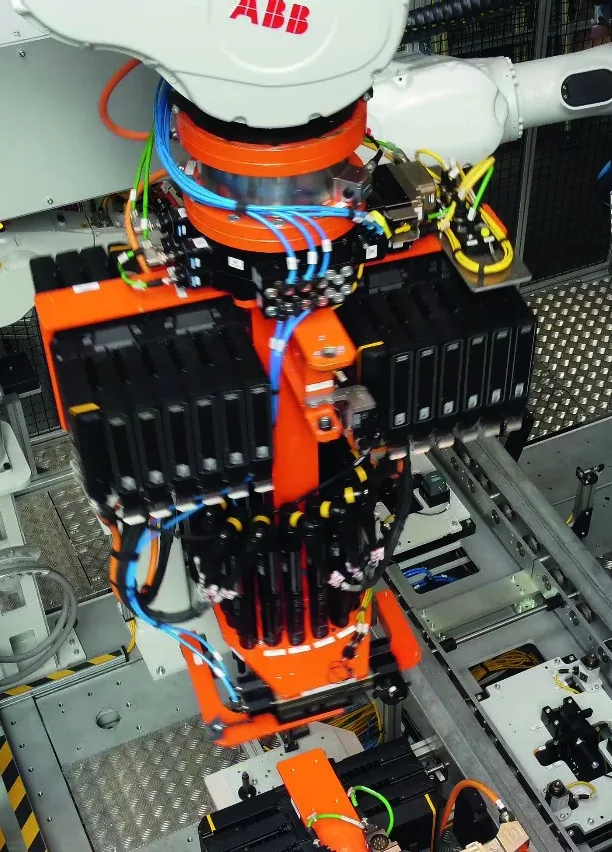
Every joint made correctly – and documented
A threaded joint is one of the most common, yet most underestimated, sources of defects. Tightening torque alone does not tell the whole story – a screw may reach the target torque because it seized on a damaged thread or on contamination, not because the joint was correctly tensioned. That is why, in critical processes, we monitor torque, rotation angle, time and the tightening profile simultaneously.
We deliver the tightening station as a complete solution – from joint analysis to service.

What problems does controlled tightening solve?
Please check whether any of the problems below apply to your process.
- Under-tightened or over-tightened joints, or joints made in the wrong order – especially when there are many screws on one part.
- Damaged threads and costly assembly rework – disassembly, replacement of components, reassembly.
- Missed screws or the wrong fastener – an error that often only comes to light at the customer’s site.
- No Poka-Yoke and no link between the result and the product – there is no way to establish how a specific part was tightened.
- Poor ergonomics and time lost picking screws – the operator searches, counts and feeds components by hand.
How does a controlled tightening station work?
The station guides the operator or the machine through the correct assembly sequence:
- The system recognises the product and selects the tightening programme.
- The screen or the machine indicates which joint to make next.
- Each joint is evaluated against an acceptance window: torque, angle and time.
- The part is released to the next stage only when all joints have been made correctly.
- The results are sent to the station database or the customer’s system together with the product ID, programme and operator.

Functional scope of the solution – what it means in practice
What does the functional scope include?
The choice depends on volume, number of variants, takt time and quality requirements. Whatever the variant, every tightening operation is monitored and recorded.
Manual, semi-automatic or automatic station – which should you choose?
| Station type | Equipment | When it is the right fit |
|---|---|---|
| Manual | industrial screwdriver, reaction arm, on-screen operator guidance, Poka-Yoke | shorter runs and many variants |
| Semi-automatic | the operator loads and unloads the part, tightening is performed by a mechanism or head; automatic screw feeding | high volumes where the operator still handles the part |
| Automatic | multi-spindle head or robot-guided screwdriver | large runs and repeatable parts, in-line operation |
We write more about choosing the type of workstation in our article on automatic, semi-automatic and manual assembly stations.
What you gain from a controlled tightening system
Typical industrial applications
- Automotive – assembly of modules, housings, interior components and sub-assemblies where every joint must be documented (automation in the automotive industry).
- Household appliances – screwing housings together, fastening sub-assemblies, assembling structural components.
- Electronics – screwing housings and boards, where excessive torque can damage a component.
- Metalworking and machine building – assembly of machine assemblies and sub-assemblies (automation in machinery and equipment manufacturing).
We often combine tightening with pressing (presses with force and displacement monitoring) and vision completeness inspection (quality inspection machines) in one station or line (production automation and dedicated lines).

Applications in the defence industry
Controlled assembly of weapon parts, armament assemblies, special vehicles, military equipment and missile components. Recording the parameters of each joint supports the quality and acceptance requirements of the defence industry.
Recording torque and angle for each joint, assigned to the unit number, provides material that can be presented at acceptance and used to analyse any non-conformities.
We describe how we approach projects for the defence sector – traceability, test stations, acceptance documentation – on the page automation in the defence and aerospace industry.

Experience and reference material
MDP designs complete workstations with industrial screwdrivers, fixtures, component feeding, presence detection and result recording. We present project details during a technical meeting.

Comprehensive MDP responsibility – from idea to delivery
Process analysis, concept, mechanical and electrical design, build, PLC and robot programming, FAT, installation, commissioning and service – all with a single point of responsibility at MDP Engineering.
Let’s talk about the process worth automating
Please describe your assembly process: the number of joints, variants, quality requirements and takt time. We will propose a concept for a tightening station with torque and angle control.
Phone: +48 733 838 747, +48 733 848 755 | Email: biuro@mdpengineering.pl