

We integrate manual, semi-automatic and automatic tightening systems.
A screwdriver with torque and angle control, combined with operation sequence control, reduces assembly errors, and result recording ensures full product traceability. The station does not allow a screw to be skipped, the wrong fastener to be used or a part to be passed on if even one joint is NOK.
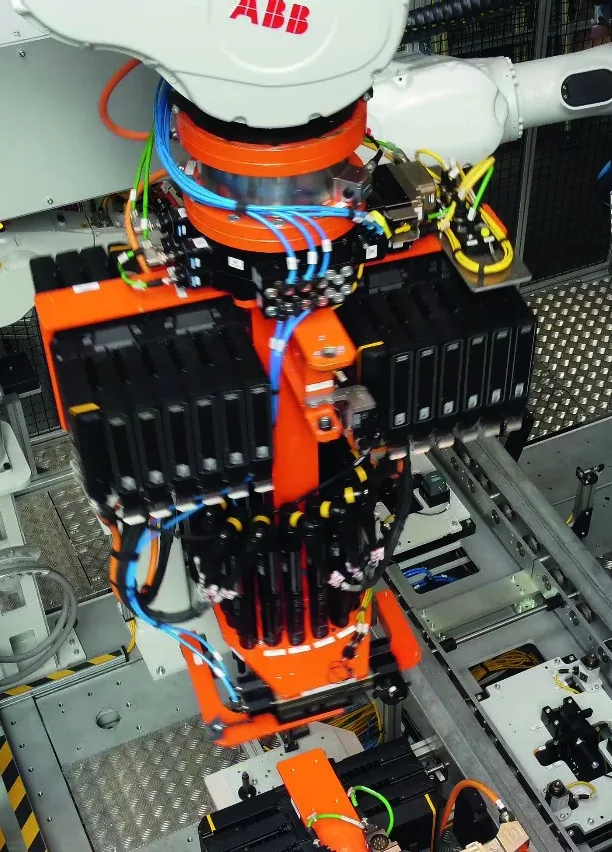
Every joint made correctly – and documented
A threaded joint is one of the most common, yet most underestimated, sources of defects. Tightening torque alone does not tell the whole story – a screw can reach the target torque because it has jammed on a damaged thread or on contamination, not because the joint has been correctly tensioned. That is why, in critical processes, we monitor torque, angle of rotation, time and the tightening profile simultaneously.
We deliver the tightening station as a complete solution – from joint analysis to service.
What problems does controlled tightening solve?
Please check whether any of the following problems apply to your process.
- Under-tightened or over-tightened joints, or joints made in the wrong sequence – especially with many screws on a single part.
- Damaged threads and costly assembly rework – disassembly, replacement of components, reassembly.
- Missed screws or the wrong fastener used – an error that often only comes to light at the customer.
- No Poka-Yoke safeguards and no link between the result and the product – there is no way to establish how a specific part was tightened.
- Poor ergonomics and time lost picking screws – the operator searches for, counts and feeds components by hand.
How does a controlled tightening station work?
The station guides the operator or the automated system through the correct assembly sequence:
- The system recognises the product and selects the tightening program.
- The screen or the automated system indicates which joint to make next.
- Each joint is evaluated against an acceptance window: torque, angle and time.
- The part is released to the next stage only after all joints have been made correctly.
- The results are sent to the station database or the customer’s system together with the product ID, the program and the operator.

Functional scope – what it means in practice
What does the functional scope cover?
The choice depends on volume, number of variants, takt time and quality requirements. Whatever the variant, every tightening operation is monitored and recorded.
Manual, semi-automatic or automatic station – which to choose?
| Station type | Equipment | When it works best |
|---|---|---|
| Manual | industrial screwdriver, reaction arm, on-screen operator guidance, Poka-Yoke | shorter runs and many variants |
| Semi-automatic | the operator loads and unloads the part, tightening is performed by a mechanism or head; automatic screw feeding | high volumes where the operator still handles the part |
| Automatic | multi-spindle head or robot-guided screwdriver | large series and a repeatable part, in-line operation |
We write more about choosing the station type in our article on automatic, semi-automatic and manual assembly stations.
What you gain with a controlled tightening system
Typical industrial applications
- Automotive – assembly of modules, housings, interior components and sub-assemblies where every joint must be documented (automation in the automotive industry).
- Household appliances – screwing housings together, fixing sub-assemblies, assembling structural components.
- Electronics – screwing housings and boards, where excessive torque can damage a component.
- Metalworking and machinery – assembly of machine assemblies and sub-assemblies (automation in the machinery and equipment industry).
We often combine tightening with pressing (presses with force and displacement monitoring) and vision completeness inspection (quality inspection machines) in a single station or line (production automation and dedicated lines).

Applications in the defence industry
Controlled assembly of weapon parts, weapon assemblies, special vehicles, military equipment and missile components. Recording the parameters of every joint supports the quality and acceptance requirements of the defence industry.
A record of torque and angle for every joint, assigned to the unit number, is material that can be presented at acceptance and used in the analysis of any non-conformities.
We describe how we approach defence-sector projects – traceability, test stations, acceptance documentation – on the page automation in the defence and aerospace industry.

Experience and references
MDP designs complete workstations with industrial screwdrivers, fixtures, component feeding, presence inspection and result recording. We present project details during a technical meeting.

End-to-end responsibility at MDP – from idea to delivery
Process analysis, concept, mechanical and electrical design, build, PLC and robot programming, FAT, installation, commissioning and service – under a single point of responsibility at MDP Engineering.
Let’s talk about the process worth automating
Please describe your assembly process: the number of joints, variants, quality requirements and takt time. We will propose a concept for a tightening station with torque and angle control.
Phone: +48 733 838 747, +48 733 848 755 | Email: biuro@mdpengineering.pl